Sunday, 16 August 2015

Yamaha Alpha gets three new colour options


Yamaha Motor India has introduced three new colour schemes for the Alpha. These dual-tone colour schemes are called Rocking Red – red with black, Beaming Blue – blue with gold, and Gleaming Gold – white with gold.

The other colours will still be available, taking the count to a total of eight colour options to choose from. For the new colour schemes, Yamaha is charging a premium of Rs 1,000 over the other colours, which sets the price of the Alpha slightly below Rs. 50,000 (ex-showroom, Delhi).

Under the skin, nothing has been changed, and the scooter still comes with the 113cc, single cylinder, four-stroke engine which makes 7.1bhp. The Alpha was launched last year with Yamaha’s Blue Core technology.


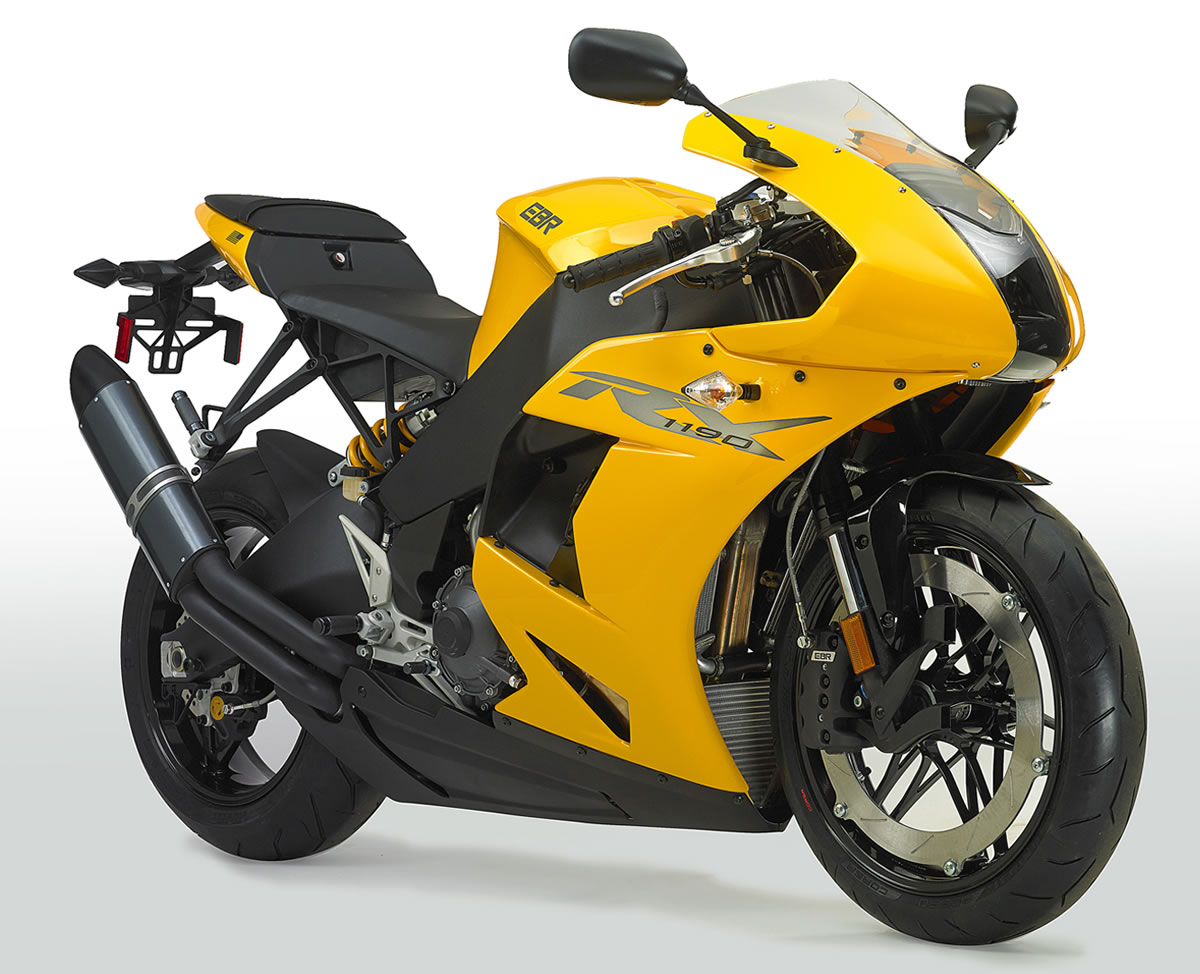
Eric Buell Racing bought over


Eric Buell Racing was sold at an auction recently for a mere USD 2.25 million (approximately Rs 14 crore). In 2013, Hero MotoCorp had paid a lot more at Rs 159 crore to purchase a 49.2 percent stake in EBR. In addition, an extra Rs 17 crore was paid to purchase EBR’s consultancy arm. At the auction, official records showed that EBR had $20.8 million (Rs 132 crore) in assets and $20.4 million (Rs 130 crore) in liabilities.


EBR was sold to a company called Atlantic Metals Group LLC, and no other details of the company were revealed by the court. This deal includes all assets necessary to manufacture EBR bikes, like the tools, machinery and the inventory of remaining bikes and spare parts. Valuable intellectual property is also part of this deal. No official statement has been released by Eric Buell or the buyers.

Friday, 14 August 2015

Lamborghini Aventador Superveloce Roadster showcased at Pebble Beach


At the ongoing Pebble Beach Concours, Lamborghini has taken the wraps off the open-top version of its Aventador Superveloce. The Aventador Superveloce Roadster goes on sale internationally next year. Like its coupé sibling, only 500 units of the Aventador SV Roadster will be produced.


These Superveloce (SV) are lighter, more powerful versions of the regular Lamborghini Aventador. Performance figures of the Aventador SV Roadster are pretty much identical to the SV. Power comes from the same 6.5-litre V12 engine, producing 740bhp at 8400rpm - a full 49bhp more than the 641bhp on offer in the regular Aventador. Power is sent to all four wheels through a seven-speed automated manual transmission.


Despite a slight increase in weight (1575kg versus 1525kg for the coupé), the SV Roadster is still capable of reaching 100kph from a standing start in 2.9sec, versus 2.8sec for the coupé. Perhaps most impressive is its top speed of 350kph, which matches the coupé.

The Lamborghini Aventador SV Roadster gets a stripped-out cabin, which incorporates carbonfibre fabric for the seats and parts of the interior trim, as well as Alcantara and leather. There’s also Lamborghini's digital instrument cluster.


Lamborghini says the SV Roadster's hard-top is made of carbonfibre and features a quick release system that adds just 6kg in weight, and that the design of the hard-top has been optimised in a wind tunnel for aerodynamic efficiency. The glass rear screen can be raised or lowered from inside the cabin, acting as a wind deflector when the roof is down.

Recall announced for Honda CBR 150R and CBR 250R


Honda Motorcycle and Scooter India has announced a recall for its CBR 150R and CBR 250R to check for a possible fault with the starter relay. The announcement is part of a global recall issued by Honda Motor Company as the starter relay is shared with the international models as well.

The recall is a precautionary step to check for and replace defective starter relay switches due to incorrect application of the sealant. According to Honda, the defective switch may lead to a sudden loss of electrical power at any time, and worst-case scenario it could cause a fire in the part.

Honda will be checking all CBR 150R and 250R motorcycles manufactured between June 2014 and June 2015 for this defect and, if found, will rectify it free of cost irrespective of warranty, at the company's service centres.

Audi Q7 Facelift

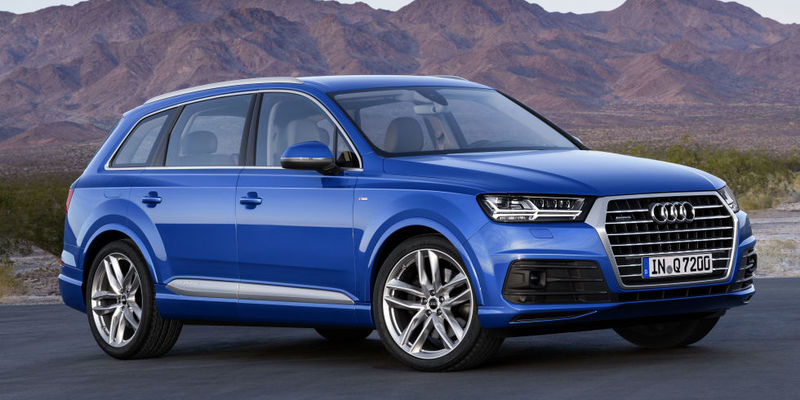
The Porsche Cayenne and VW Touraeg have both got major updates this year so it only seemed obvious that the Audi Q7 be updated too. Now, Audi has taken the wraps off the 2015 Q7 SUV and it appears to have undergone some major cosmetic reconfiguration.

The flagship SUV from the Ingolstadt- based automaker retains an all too familiar shape but is now a whopping 325kgs lighter and roughly 26 per cent more efficient than the outgoing model. The SUV tips the scales at 1995-kgs and has managed to pull off this task thanks to an all-new aluminum-steel chassis and multi-material body composition.

Exterior:


The 2015 Q7’s fascia reflects the German automaker’s new design philosophy which now sees its cars moving away from the previous two generation’s rounded edges to much sharper features. The headlights can now be configured in the form of Xenon’s, LEDs or matrix LED headlights. What appears to be standard across all three headlight setups are the arrow- shaped LED daytime running lights with the top-spec models getting the integrated turn signals.
The side profile appears to have been retained from the outgoing model but the roofline has a sharper rake at the rear end and it appears that the whole roof has also been lowered slightly. The bulging wheel arches add to the butch look of the vehicle while there is some contrast coloured moulding on the base of doors. The designs of the alloy wheels too are different now, though we expect that the company is likely to continue offering the older shapes depending on the market.
The rear, like the fascia, gets sharper lines giving a square appearance to the overall design but thanks to the forward rake of the glass does not look out of place. The entire mid-section below the tail lamps has been reworked and thereare two bulge- like design elements on which the badging have been placed. Finally, the exhaust tail pipes have been changed and thanks to the new design philosophy are now flatter and rectangular in shape.

Interior:


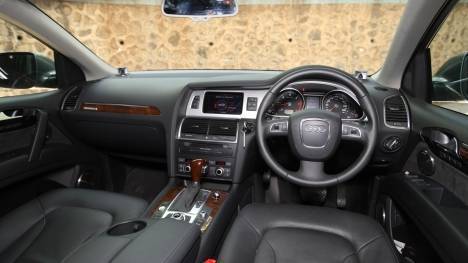
Less is more seems to be the new philosophy for Audi as it has simplified the cabin design by decreasing the size and number of the elements on the dashboard. The steering, instrument panel and climate control system all appear to be new while the screen has moved from being in the dashboard to the top of it and has now also become larger as well a touchscreen unit. It now uses Audi’s latest MMI system while offering support for Android Auto as well as Apple Car Play. Adding to this package is either a Bose system or a 23-speaker B&O surround sound system.

In conformity with the reducing design, the gear lever is now a smaller unit but other than that all elements look to be carried over and in the same places too. If the front gets so much, then the rear too looks to be a fun place. It can be configured with one or two 10.1-inch tablets that boast of a 32GB memory and full HD camera (for when that car selfie moment happens). Like its predecessors, the 2015 Q7 boasts of three rows of seats and lots of storage spaces.
Engine and gearbox
The Q7 is being offered with the 3.0-litre TDI diesel mill which in higher- spec models produces 272bhp and 600Nm of torque. It is also available in a lower spec config where it produces 218bhp and 500Nm of torque.

On the petrol front, the engine is a 3.0-litre unit that produces 333bhp and 440Nm of torque. There is also expected to be a 2.0-litre petrol engine which will produce 252bhp and 370Nm of torque. This engine will be offered only for the Asian markets. This Q7 also debuts Audi’s new 3.0-litre plug-in hybrid diesel engine that will produce 373bhp and 700Nm of torque. All engines are offered with an 8-speed AT and Quattro system as standard. Audi is now also offering an all-wheel steering on some specific models.

Jaguar XE


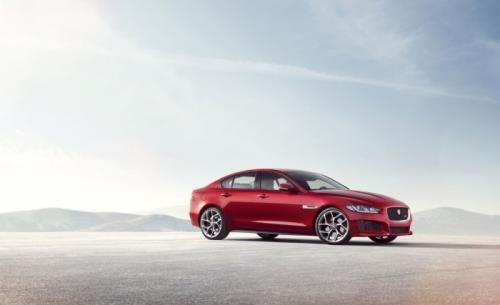
Jaguar has always been known to produce cars that slot into the higher sections of the premium category and this has been evident since the new look XJ and XF began production in 2009. It has however been missing a contender in the entry-level sports segment which is dominated by cars like the BMW 3 Series, Audi A4 and the Mercedes-Benz C-Class. However, this will now change when it launches the XE sports sedan next year. Aimed at giving the British manufacturer a chance at the volumes game we can expect to see an Indian debut by the middle of next year.

Exterior:

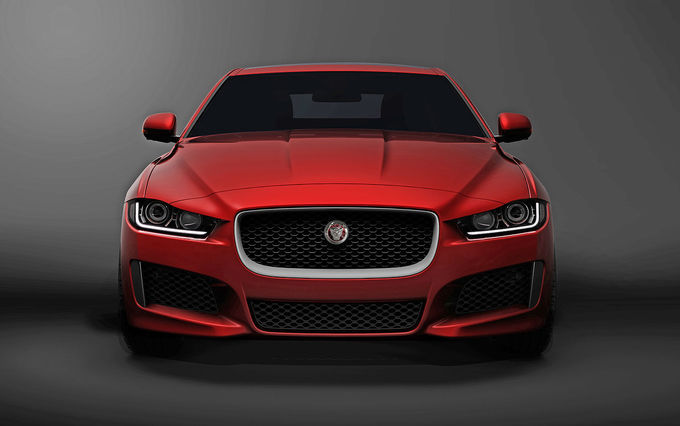
The Jaguar XE, in the released publicity material and spy shots, looks exactly like the larger XF and the flagship XJ. This is a common practice among all the manufacturers partly due to economies of scale and partly due to the fact that it is easy for them to adapt a successful design across all their models to retain familiarity of product.
The Jaguar XE will get a smaller version of the XF’s massive chrome mesh grille complete with the leaping cat. Standard features are expected to be projector headlights, LED daytime lights and projector fog lamps. We even expect that the bumper will remain the same but with a higher ground clearance.
The side profile is also similar to that of the XF in terms of roof line, flared wheels arches and the rake angle of the roof line both in the front and back. However, while the boot will have similar design elements as the XF and XJ-like tail lamp cluster and chrome strips, it appears to be far smaller (in relation to the larger cars). The rear bumper is expected to be a little sportier and will be complemented by dual exhausts.

Interior:

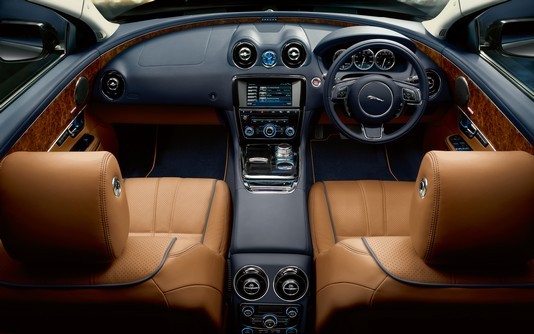
While the exteriors are clear thanks to the plethora of spy shots and press release images, the interiors are still a mystery. However, given the theme of continuation on the outside, we expect that it will be no different inside. The overall design is expected to be very close to that of the XF and XJ but with the obvious cost cutting measures like fabric/Alacantra seats and shiny but high quality plastic in place of wood for the trim options.

We expect that the infotainment system, climate control and instrumentation will remain the same but there will none of the Houdini-like hidden vents and rotary dial appearing from hidden crevices. Instead we believe that there will be a standard gear lever and fixed gear selection dial in the cabin. The rear seat space will adequately seat two persons in full comfort thanks to the transmission tunnel and the rear AC unit.
Engine and gearbox
The XE will be the British automaker’s first vehicle to be derived from an all-new aluminium platform and engine family called Ingenium which will comprise units in the capacity of 1.8-litres to 2.5-litres and have power outputs in the range of 184bhp to 300bhp. There is also expected to be a top-of-the-line RS variant which will be powered by the 3.0-litre V6 unit from the F-Type range.


This family has both petrol and diesel engines and will be mated to either a six-speed manual or the ZF eight-speed automatic gearbox which will send power to the rear wheels or to all four-wheels in a 60:40 ratio.

Price and competition:

We expect that Jaguar will price the XE in the range of Rs 28 lakh to Rs 45 lakh and launch it in mid- 2015. It will compete with the BMW 3 Series, Audi A4 and the Mercedes-Benz C-Class. The biggest move is expected to be that Jaguar will locally assemble the car in India in a bid to price it as competitively as possible.


Thursday, 13 August 2015

Harley-Davidson Street 750 continues to dominate RE Continental GT


On April 16, 2015, our sister publication Autocar Professional's report stated that Harley-Davidson’s India-built midsized cruiser Street 750 had drawn more buyers in the domestic market than its segment (engine displacement wise) competitor – Royal Enfield’s Continental GT during FY2014-15. The Q1 (April-June 2015) sales results for FY2015-16 highlight that Harley-Davidson’s liquid-cooled, V-twin, 749cc cruiser, continues to dominate Royal Enfield’s air-cooled, single-cylinder, 535cc café racer styled model in terms of finding buyers in the domestic market.

While the Street 750 sold 524 units in Q1 FY2015-16, the Continental GT recorded sales of 434 units during the same period. Both models, however, have recorded a decline when compared with their respective Q1 FY2014-15 sales. The Street 750 and the Continental GT had sold 619 and 859 units respectively in Q1 FY2014-15.

Despite the Street 750’s starting price tag of Rs 4,32,000 (ex-showroom, Delhi), which is more than double the sticker price of the Royal Enfield Continental GT (which comes for close to Rs 2,10,000, on-road, Delhi), the popularity of the former clearly underlines Indian bike buyers’ aspirational values, preference for ever-lasting build quality, and the strong brand pull that the American motorcycle manufacturer commands.


The Harley-Davidson Street 750 continues to be the top seller in the midsized motorcycle category of engine displacement of more than 500cc but less than equal to 800cc. This sub-category has seen a year-on-year fall of 28.34 percent thereby selling 490 units fewer as compared to its Q1 FY2014-15’s sales of 1,729 units. While the Street 750 and the Continental GT drive this sub-category, Kawasaki’s 71bhp 649cc Ninja 650 and Er-6n and Triumph Motorcycles’ 117bhp 675cc Daytona variants (675R and Daytona 675 ABS), 78bhp 675cc Street Triple ABS, and the 94bhp 800cc Tiger 800 variants (XRx and XCx) are the other prominent midsized motorcycles that make up the category in this engine displacement class.


Reporting decent growing numbers, Triumph Motorcycles’ above-mentioned products in this category, on the other hand, saw sales of 128 units during Q1 FY2015-16 as against 96 units sold in Q1 FY2014-15. It can be recalled that the British premium bike maker had, on March 12, expanded its CKD portfolio for India by rolling out two new variants in its adventure tourer portfolio – Tiger XRx and Tiger XCx, which offer on-road and off-road riding applications respectively. By doing so, the company had brought down the price tag of the 800cc Tiger models as Tiger 800 XC earlier was imported into India as a CBU.